Weekly Column
In Defense of Chaotic Good
In 2018, an internal communication from Elon Musk to his employees leaked to the press. Musk, in one of his bullet points, stated: "Communication should travel via the shortest path necessary to get the job done, not through the 'chain of command.' Any manager who attempts to enforce chain of command communication will soon find themselves working elsewhere."
This quote may seem straightforward and topical, but it hovers over a mythological duality that plays out daily in every company built by humans: the conflict between order and chaos — chaos loosely defined as fluidity of action or communication outside the stated organizational structure.
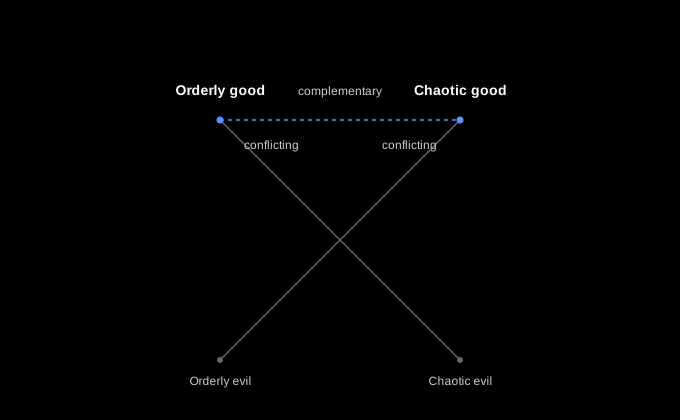
Order, as it guides human labor, benefits an organization. Order, as a rigid structure that must be adhered to, stifles the chaos of a worker's initiative, instinct, and progressing abilities. Chaotic good — employees acting outside the published structure for the good of the company — pushes an organization forward without breaking order. If order is allowed to stifle this chaos, the result is often stovepiping, low morale overall, and ultimately distrust of prescribed leaders.
A company should only have as much order as is absolutely necessary. Order, by nature, sets boundaries and limitations. Order does not innovate; it doesn't try new things. Strict order may provide the boundaries necessary to direct and organize someone's efforts, but learning and striving will push past those boundaries in a way that serves the mission of the company.
Recently, I worked with a man obsessed with organizational charts, who insisted our relatively small company not only delineate and adhere to one, but that working outside of that org chart — even for the good of the company, even well within one's scope of knowledge and practice — should be met with direct discouragement. A better way to lose talented, enthusiastic employees can hardly be imagined. And most leaders simply accept the insanity of the reasoning. I picked up a client's login anomaly. I called Lev, our security man, to get his eyes on it with me. We solved the issue. End of the story, yes? No — I got a call from Tim, my manager, asking why I didn't bring it to him to go through Lev's manager first. That's four points of contact to do what two people just did: me to Tim to Lev's manager to Lev. I'm a blunt person. I asked, "Why would I do that?" Tim said, "Because that's following the org chart." And this reasoning — "because this says so" — is somehow accepted by smart, otherwise reasonable people.
This may seem to demonize org charts, but I want to cut through something deeper: org charts, as written and distributed, come across as concrete and final. I've found humans, especially humans eager to learn and attempt, anything but. Any life-long learner will spread his wings as broadly as he's able. Tim called me to ask why Cody was working on project C when project C was technically outside his scope. "Because he's talented at it and specifically asked me to give him a shot at it," I said. Tim said, "Well, that's outside the org chart." So re-write your org chart.
An employee acting outside his scope but within his ability should not be chastised lightly. Good people — especially good employees who understand their market value — will tolerate only so much criticism for their initiative before they accept some other job that allows them the leniency to operate. If your employee consistently breaks his scope to perform tasks he's competent to do, maybe you should change his scope rather than changing his behavior.
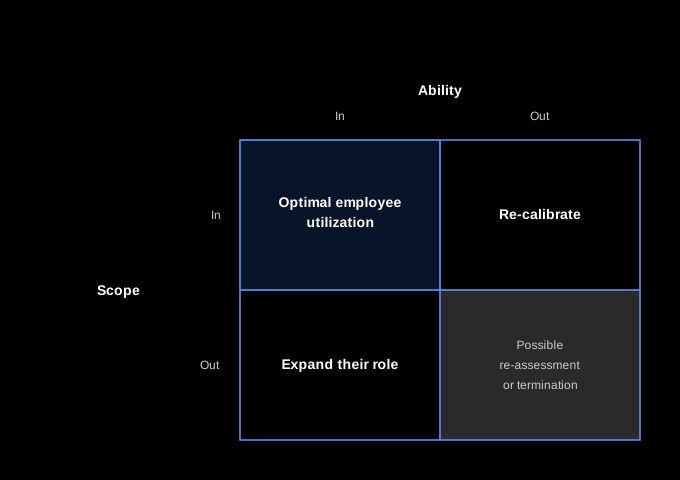
Musk's directive echoes well beyond this practical org chart example. It's a recognition that the moment a structure exists to protect itself rather than the mission it was built to serve, that structure has become the threat. Lev and I closing out a login anomaly in twenty minutes was chaotic good. Cody taking a shot at project C was chaotic good. It served the company. Four points of contact instead of two, dressed up as order, will kill everything good about your company faster than any disorganization ever could.
— Daniel